

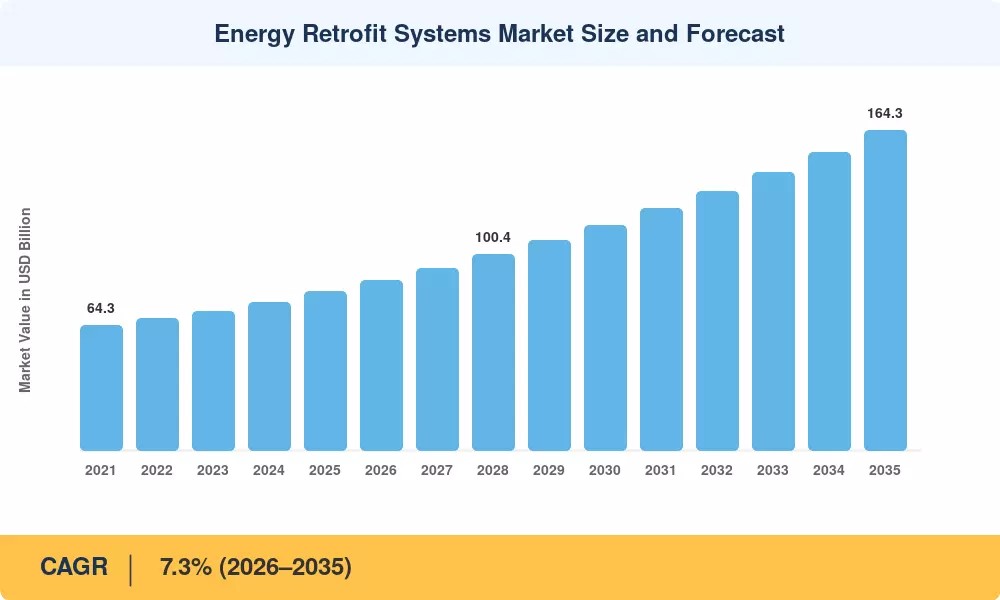
Energy Retrofit Systems Market to Reach USD 164.3 Billion by 2035 at 7.3% CAGR.
Energy Retrofit System Share
Lighting retrofit solutions account for an estimated USD 12.8 billion in 2025 revenue, driven by commercial building conversions to networked LED systems.
Commercial buildings represent the dominant application segment in the Energy Retrofit Systems Market, holding approximately 42% revenue share in 2025.”
NEW YORK, NY, UNITED STATES, July 29, 2026 /EINPresswire.com/ -- The global Energy Retrofit System Market reached an estimated USD 81.4 billion in 2025 and is projected to grow from USD 87.3 billion in 2026 to USD 164.3 billion by 2035, registering a CAGR of 7.3% during the forecast period (2026–2035).— Prashant Hake
Market Overview
Energy Retrofit Systems Market encompass the technologies, equipment, and services deployed to improve the energy efficiency and environmental performance of existing buildings. These systems include HVAC upgrades, building envelope improvements (insulation, windows, air sealing), LED lighting conversions, building automation and controls, and renewable energy integration such as rooftop solar and battery storage. Buildings account for roughly 37% of global energy-related CO₂ emissions, and governments from the European Union to the United States have responded with aggressive decarbonization mandates that funnel capital directly into retrofit activity. The U.S. Inflation Reduction Act alone earmarked over USD 9 billion in rebates and tax credits for residential and commercial energy upgrades, creating a powerful demand catalyst for the market through 2032.
The market's robust growth is anchored in several converging forces. Regulatory pressure is the most influential growth driver, with the EU's revised Energy Performance of Buildings Directive (EPBD) requiring member states to renovate the worst-performing 15% of non-residential buildings by 2030, with residential buildings following by 2033. In the United States, New York City's Local Law 97 imposes escalating carbon penalties on buildings over 25,000 square feet, with fines exceeding USD 268 per metric ton of CO₂ above threshold, making retrofitting cheaper than non-compliance for most large commercial properties. Japan's revised Energy Conservation Act similarly tightens performance benchmarks for existing commercial structures.
Private-sector energy service companies (ESCOs) have scaled their project pipelines by more than 22% year-over-year since 2022, deploying performance-based contracts that remove upfront cost barriers for building owners. The U.S. ESCO industry generated approximately USD 9.5 billion in revenue in 2023, with federal ESPC (Energy Savings Performance Contracts) representing roughly 35% of total volume. Rising commercial energy costs further accelerate the payback of efficiency projects, with commercial electricity prices across OECD countries increasing by 28% between 2021 and 2024. HVAC and building envelope improvements can cut commercial energy use by 30 to 50%, resulting in payback periods of less than five years at current energy costs in most industrialized nations.
Asia-Pacific is the fastest-growing region with a projected CAGR of 8.9%, fueled by China's aggressive building energy efficiency targets, Japan's Zero Energy Building roadmap, and India's Energy Conservation Building Code updates. Europe maintains the second-largest revenue share at 30%, anchored by the EU Renovation Wave strategy targeting 35 million building units by 2030. As aging building stock across all major economies approaches critical replacement thresholds, the retrofit value chain is poised for sustained double-digit investment growth in several sub-segments through 2035.
Get Free Sample Report for Detailed Market Insights:
https://www.marketresearchfuture.com/sample_request/11758
Market Segmentation
The Energy Retrofit Systems Market is comprehensively segmented across technology, application, end-user, and retrofit depth categories. By technology, HVAC system retrofits command the largest share at approximately 36% of the market, reflecting the global push to replace fossil-fuel heating with electric heat pump solutions. Heat pump installations across Europe grew by over 38% in 2023 compared to 2022, driven by gas price volatility and national subsidy programs. Building envelope upgrades—including insulation, fenestration, and air-sealing—are forecast to grow at the fastest rate among technology segments at 8.4% CAGR through 2035, driven by tightening insulation standards and building code requirements. Lighting retrofit solutions account for an estimated USD 12.8 billion in 2025 revenue, driven by commercial building conversions to networked LED systems with integrated controls. Building automation and controls represent the fastest-growing technology segment, propelled by declining sensor costs and cloud-based analytics platforms that enable real-time energy optimization, reducing HVAC energy consumption by 15–30% with payback periods under two years in commercial applications.
By application, commercial buildings represent the dominant segment holding approximately 42% revenue share in 2025, driven by a convergence of regulatory mandates, ESG reporting requirements, and favorable project economics at scale. Office buildings, retail centers, and hotels typically offer the largest energy savings potential per dollar invested, with deep retrofits routinely achieving 30–50% energy reduction. Residential retrofit activity is growing at a projected CAGR of 7.8%, supported by government rebate programs including the U.S. Home Energy Rebates program providing up to USD 8,000 per household for heat pump installations. Industrial facility retrofits generated approximately USD 11.4 billion in 2025 as manufacturers pursue ISO 50001 energy management certification and seek to reduce energy costs. By end-user, building owners and operators account for 48% of market spending, while ESCOs represent the fastest-growing segment at 8.6% CAGR through performance contracting expansion.
You can buy this market report at:
https://www.marketresearchfuture.com/checkout?currency=one_user-USD&report_id=11758
Regional Analysis
North America leads the Energy Retrofit Systems Market with approximately 34% of global revenue, with the United States accounting for 82% of regional share. The U.S. market is driven by a layered incentive structure combining federal IRA tax credits with state and utility programs. California's Title 24 standards, New York's Local Law 97, and Washington state's Clean Buildings Performance Standard collectively cover over 1.2 billion square feet of commercial space under mandatory performance requirements. Canada's federal carbon price, scheduled to reach CAD 170 per tonne by 2030, is driving accelerated heat pump adoption across provinces. Mexico's CONUEE commercial building programs contribute a smaller but growing share at USD 1.1 billion in 2025.
Europe holds the second-largest share at 30%, benefiting from the strongest regulatory framework globally. The EPBD recast mandates zero-emission buildings for new construction by 2030 and requires member states to establish national renovation trajectories targeting the worst-performing building segments. Germany, representing 26% of regional share, disbursed over EUR 14 billion in renovation subsidies through KfW in 2023, while France's MaPrimeRénov' program processed over 700,000 household applications in the same year. The UK's commitment to phase out new gas boiler installations by 2035 is creating a structural demand shift toward heat pump retrofits across its 28 million residential dwellings.
Asia-Pacific represents the fastest-growing region at 8.9% CAGR, driven by China's 14th Five-Year Plan setting explicit targets for green building retrofits covering over 350 million square meters of existing public buildings. Japan's ZEB (Zero Energy Building) roadmap targets net-zero energy performance for all new commercial buildings by 2030, with existing building retrofit subsidies through METI supporting the transition. India's updated Energy Conservation Building Code mandates minimum performance standards for commercial buildings exceeding 500 kW of connected load, with the Bureau of Energy Efficiency estimating that retrofitting just 30% of existing commercial buildings could yield annual energy savings of over USD 3.5 billion. South America and the Middle East & Africa represent emerging markets, with Brazil's PROCEL program expanding its commercial building labeling scheme and the UAE's Demand Side Management Strategy targeting a 30% reduction in energy demand by 2030 through building retrofits.
Competitive Landscape
The Energy Retrofit Systems Market is moderately fragmented, with an estimated top five players collectively holding approximately 22–28% of global revenue. The competitive field spans multinational building technology conglomerates, specialized ESCOs, large engineering-procurement-construction firms, and regional contractors. Johnson Controls holds 5–7% market share with its OpenBlue platform and integrated controls services, having launched the OpenBlue Net Zero Advisor platform in September 2024, an AI-driven tool that generates building-specific retrofit roadmaps. Honeywell commands 4–6% share through its Forge platform and energy management solutions, while Siemens holds 4–6% with Desigo CC building automation and digital twin integration. Schneider Electric captures 3–5% through its EcoStruxure software-centric portfolio, and Trane Technologies holds 3–5% with a climate-focused OEM strategy. Ameresco, a pure-play ESCO model, holds 2–4% share specializing in federal ESPC contracts and distributed energy projects.
Scale advantages in the market accrue primarily through technology portfolios, project financing capabilities, and installed-base relationships rather than manufacturing capacity. The ESCO model has transformed the retrofit market by absorbing project performance risk and eliminating upfront capital requirements for building owners, effectively monetizing future energy savings to create self-funding mechanisms that scale the addressable market well beyond what traditional capital expenditure budgets would support.
Latest Industry News & Developments
In September 2024, Johnson Controls launched the OpenBlue Net Zero Advisor platform, an AI-driven tool that generates building-specific retrofit roadmaps and ROI projections for commercial portfolio owners. In February 2025, ABB and Samsung Electronics combined ABB's InSite platform with SmartThings to improve household and light-commercial energy management. In January 2025, ABB made an investment in Toronto-based Edgecom, a generative AI energy management firm, enabling commercial and industrial users to efficiently control and reduce power consumption peaks. In March 2026, Mitsubishi Heavy Industries Asia Pacific received an award from Singapore's National Environment Agency for boiler refurbishment work at the Tuas South Incineration Plant to extend operational life and stabilize waste processing capacity.
Market Challenges & Opportunities
Despite favorable long-term economics, the initial investment required for comprehensive building retrofits remains a significant barrier. A deep energy retrofit of a mid-size commercial building typically costs USD 25–75 per square foot, with total project costs regularly exceeding USD 1 million. While ESCOs and green financing mechanisms have expanded access, small and mid-size building owners often lack the credit profiles or project scale to qualify for performance-based contracts. The IEA estimates that closing the global building efficiency investment gap requires tripling current annual spending to approximately USD 270 billion by 2030. Skilled labor shortages in building trades further constrain project throughput, with the U.S. construction industry needing to hire between 350,000 and 450,000 net new workers annually until 2027. The split-incentive problem—where building owners pay for retrofits but tenants benefit from energy savings—affects over 40% of commercial floor space globally.
However, significant opportunities are emerging across multiple dimensions. Emerging market retrofit programs across Southeast Asia, Latin America, and Sub-Saharan Africa represent greenfield territory, with international development banks committing over USD 12 billion in building efficiency lending facilities through 2030. Digital twin and AI-driven retrofit optimization platforms can identify optimal retrofit sequences with greater than 90% accuracy, reducing project risk and compressing sales cycles. Net-zero whole-building retrofit packages that combine envelope, mechanical, controls, and on-site renewable generation achieve 40–60% energy reduction compared to 15–25% for single-measure retrofits. The electrification of space and water heating represents a multi-decade retrofit wave, with the IEA projecting global heat pump installations must reach 600 million units by 2030 to align with net-zero pathways, up from approximately 190 million in 2022. Industrialized retrofit approaches using prefabricated components can reduce on-site installation time by 50–70%, making retrofits viable for building categories previously considered too disruptive or costly to upgrade.
To explore more market insights, visit us at:
https://www.marketresearchfuture.com/reports/energy-retrofit-systems-market-11758
Final Market Summary
The Energy Retrofit Systems Market is positioned for sustained growth, with projections indicating a doubling of market value from USD 81.4 billion in 2025 to USD 164.3 billion by 2035, at a CAGR of 7.3%. This growth is underpinned by aggressive government decarbonization mandates, building performance standards, federal tax credits and rebates, rising commercial energy costs, and the expanding ESCO model that removes upfront capital barriers for building owners. While challenges including high upfront costs, skilled labor shortages, and split-incentive problems persist, emerging opportunities in digital twin optimization, whole-building retrofit packages, heat pump electrification, and emerging market programs offer significant potential for industry participants. The future market landscape will be defined by companies that successfully integrate AI-driven analytics, deliver turnkey multi-measure packages, and scale industrialized retrofit approaches while navigating fragmented regulatory standards and labor constraints across global markets.
More Related Reports from MRFR Library:
Mobile Substation Market: https://www.marketresearchfuture.com/reports/mobile-substation-market-5461
Tidal Energy Market: https://www.marketresearchfuture.com/reports/tidal-energy-market-5478
Diesel power engine Market: https://www.marketresearchfuture.com/reports/diesel-power-engine-market-5508
High Speed Motor Market: https://www.marketresearchfuture.com/reports/high-speed-motor-market-5606
Portable Generator Market: https://www.marketresearchfuture.com/reports/portable-generator-market-5854
Field Erected Cooling Tower Market: https://www.marketresearchfuture.com/reports/field-erected-cooling-tower-market-5871
Drilling Tools Market: https://www.marketresearchfuture.com/reports/drilling-tools-market-5885
Load Break Switch Market: https://www.marketresearchfuture.com/reports/load-break-switch-market-5889
Enhanced Oil Recovery Market: https://www.marketresearchfuture.com/reports/enhanced-oil-recovery-market-5900
Molded Case Circuit Breakers Market: https://www.marketresearchfuture.com/reports/molded-case-circuit-breakers-market-5902
Larry Wilson
WantStats Research And Media Pvt. Ltd.
+ +1 855-661-4441
email us here
Visit us on social media:
LinkedIn
Facebook
YouTube
X
Legal Disclaimer:
EIN Presswire provides this news content "as is" without warranty of any kind. We do not accept any responsibility or liability for the accuracy, content, images, videos, licenses, completeness, legality, or reliability of the information contained in this article. If you have any complaints or copyright issues related to this article, kindly contact the author above.
